---
title: "Vertical Learning: How To Turn Classroom Walls Into Engaging Learning Spaces"
description: Discover vertical learning experiences that turn classroom walls into hands-on, engaging spaces that boost motor skills, creativity, and early learning.
image: https://blog.kaplanco.com/hubfs/blog_imgs/BLOG_Vertical%20Learning%20How%20To%20Turn%20Classroom%20Walls%20Into%20Engaging%20Learning%20Spaces_header_img_1200x600.jpg
---
[ Shop ](https://www.kaplanco.com/) [ Need help? Customer Support ](https://www.kaplanco.com/about/contactKaplan.asp)
[ ](https://blog.kaplanco.com/)
Instructional Strategies
- [ Accessibility & Inclusion ](https://blog.kaplanco.com/tag/accessibility-and-inclusion)
- [ Classroom Behaviors ](https://blog.kaplanco.com/tag/challenging-behaviors)
- [ Dual Language Learning ](https://blog.kaplanco.com/tag/dual-language-learning)
- [ Health and Wellness ](https://blog.kaplanco.com/tag/health-and-wellness)
- [ Outdoor Learning ](https://blog.kaplanco.com/tag/outdoor-learning)
- [ Social-Emotional Support ](https://blog.kaplanco.com/tag/social-emotional-development)
- [ Infant and Toddler ](https://blog.kaplanco.com/tag/infant-and-toddler)
- [ Preschool ](https://blog.kaplanco.com/tag/preschool)
- [ Early Elementary ](https://blog.kaplanco.com/tag/early-elementary)
- [ Family Engagement ](https://blog.kaplanco.com/tag/family-engagement)
Activity Inspiration
- [ Art ](https://blog.kaplanco.com/tag/art-activities)
- [ Literacy ](https://blog.kaplanco.com/tag/literacy)
- [ Math ](https://blog.kaplanco.com/tag/math)
- [ Science ](https://blog.kaplanco.com/tag/science)
- [ Social & Emotional Development ](https://blog.kaplanco.com/tag/social-emotional-development)
- [ STEM | STEAM ](https://blog.kaplanco.com/tag/stem-steam)
- [ Seasonal ](https://blog.kaplanco.com/tag/seasonal-activities)
- [ Fine & Gross Motor ](https://blog.kaplanco.com/tag/fine-and-gross-motor)
Product Resources
- [ Assessment ](https://blog.kaplanco.com/tag/assessment)
- [ Curriculum ](https://blog.kaplanco.com/tag/curriculum)
- [ Furniture ](https://blog.kaplanco.com/tag/furniture)
- [ Playground Planning ](https://blog.kaplanco.com/tag/playground-planning)
- [ Technology ](https://blog.kaplanco.com/tag/technology)
- [ Classroom Setup & Design ](https://blog.kaplanco.com/tag/classroom-setup)
- [ Professional Development ](https://blog.kaplanco.com/tag/professional-development)
- [ Learning Centers and Play ](https://blog.kaplanco.com/tag/learning-centers-play)
- [ Gift Guides ](https://blog.kaplanco.com/tag/gift-guides)
Funding Resources
- [ Grant Funding ](https://blog.kaplanco.com/tag/grant-funding)
- [ Head Start Funding ](https://blog.kaplanco.com/tag/head-start-funding)
- [ Cost Breakdowns ](https://blog.kaplanco.com/tag/cost-breakdowns)
Kaplan News
- [ About Kaplan ](https://blog.kaplanco.com/tag/about-kaplan)
- [ People/Company Culture ](https://blog.kaplanco.com/tag/people-company-culture)
- [ Customer Stories ](https://blog.kaplanco.com/tag/customer-stories)
Business Resources
- [ Starting a Child Care Business ](https://blog.kaplanco.com/tag/starting-a-child-care-business)
- [ Marketing and Growth ](https://blog.kaplanco.com/tag/marketing-and-growth)
- [ Budgeting and Cost Breakdowns ](https://blog.kaplanco.com/tag/cost-breakdowns)
# Vertical Learning: How To Turn Classroom Walls Into Engaging Learning Spaces
Latoya TorranceApril 19, 2026[Classroom Setup](https://blog.kaplanco.com/tag/classroom-setup), [Fine and Gross Motor](https://blog.kaplanco.com/tag/fine-and-gross-motor), [Learning Centers & Play](https://blog.kaplanco.com/tag/learning-centers-play)8 minute read
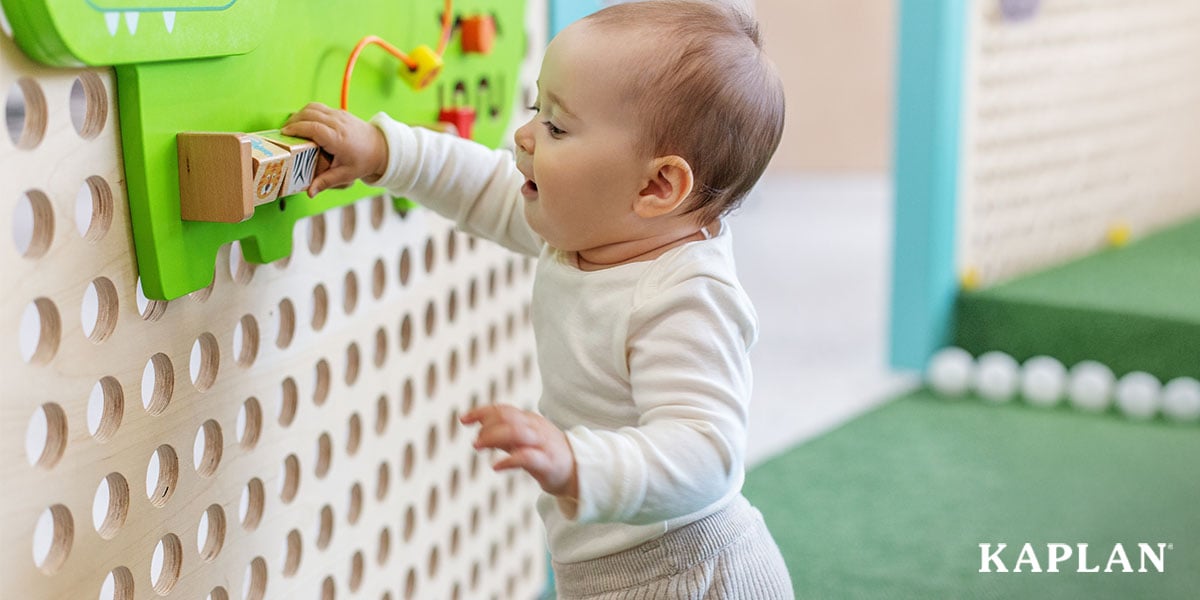
Are you making the most of your classroom walls for learning, play, and exploration?
In [Inspired by Nature: Designing Play Places for the Littlest Learners](https://www.kaplanco.com/product/300142/inspired-by-nature-designing-play-places-for-the-littlest-learners-paperback), authors Sandra Duncan, EdD, and Christine Burkholder draw inspiration from geckos, small lizards that love clinging to walls and ceilings as they bask in the sunlight. Just as geckos use vertical surfaces to move and explore, educators can do the same—using classroom walls to extend children’s play and learning.
According to Duncan and Burkholder, classroom walls are valuable real estate. They can support growth and development just as well as toys and materials on horizontal surfaces, like your tables and floors. In this article, we invite you to look beyond posters, artwork, and bulletin boards. Discover different ways to use classroom walls for vertical learning and how this supports children’s growth.
## **What is vertical learning—and why does it matter?**
Vertical learning refers to intentionally using walls and other tall, upright surfaces as active learning spaces—not just for display. Instead of playing and learning only at tables or on the floor, children are invited to explore, create, and problem-solve through hands-on activities while standing, reaching, and moving.
According to *Inspired by Nature, *there are several reasons educators should think like a gecko and use classroom walls as vertical learning spaces:
- **Promote midline crossing:** Vertical learning spaces naturally encourage cross-body movements that help both sides of the brain communicate and support healthy growth and development.
- **Support motor skills:** As children engage with vertical learning spaces, they stand upright and use movements that strengthen their core, boost arm strength and flexibility, and promote hand-eye coordination.
- **Enhance spatial awareness: **Vertical learning activities give children opportunities to explore basic spatial concepts such as up, down, high, low, left, and right.
- **Maximize classroom space: **Vertical learning environments free up floor space and are always ready for children to learn and interact.
With these benefits in mind, let’s look at practical tips for designing vertical learning spaces that invite young children to learn, move, and explore.
## **How to design vertical learning environments in your early childhood classroom**
In [Through a Child’s Eyes: How Classroom Design Inspires Learning and Wonder](https://www.kaplanco.com/product/92826/through-a-childs-eyes-how-classroom-design-inspires-learning-and-wonder-paperback), authors Sandra Duncan, Jody Martin, and Sally Haughey encourage educators to transform passive wall materials into engaging, interactive learning spaces. With that in mind, take a moment to assess your classroom walls and consider these questions to see whether your displays truly support active learning:
- What is currently posted on the walls and why?
- What is the purpose of the material I am posting?
- Do the posted materials honor children’s work and reflect who they are?
- Are most children’s interactions with the posted materials active or passive?
Reflecting on these questions helps you identify opportunities to make the most of your wall space. Before we dive into specific activities, here are some guidelines from *Inspired by Nature* for setting up vertical learning spaces that children can explore safely and independently:
**1. Keep vertical learning environments at a child’s eye level. **Activities should be easily accessible for every child in the classroom to promote engagement and autonomy. To accommodate two children playing side by side, hang the materials at least 40 inches apart.
**2. Select materials that are suitable for little learners.** Ensure the objects are safe, don’t present a choking hazard, and are durable enough to withstand repeated use and handling.
**3. Install vertical learning environments in out-of-the-way areas of the classroom. **Avoid placing them in or near high-traffic pathways or classroom doors to minimize distractions and create a safe space for movement and engagement.
> **Need help designing your early childhood classroom?** Check out these [practical tips for designing an effective classroom layout.](https://blog.kaplanco.com/why-your-classroom-layout-isnt-working-and-how-to-fix-it)
## **3 vertical learning activities to try in your classroom**
Looking for inspiration? Here are three vertical learning activities adapted from [Inspired by Nature](https://www.kaplanco.com/product/300142/inspired-by-nature-designing-play-places-for-the-littlest-learners-paperback) to offer hands-on exploration in a whole new way. Ideal for children ages 1 to 3, these activities are designed to engage children’s curiosity and imagination while strengthening key cognitive and motor skills.
### **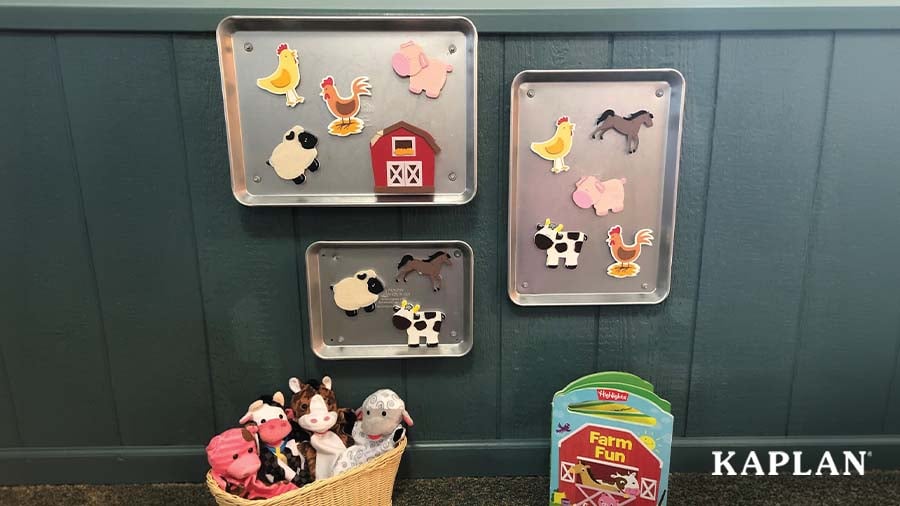 1. Baking-pan wall**
With this vertical play space, children can explore, design, and experiment using everyday objects in a whole new way.
**What you’ll need:**
- Steel baking or cookie sheet
- [Magnetic tape](https://www.kaplanco.com/store/trans/search.asp?tbSearch=magnetic+tape)
- [Magnetic objects](https://www.kaplanco.com/shop/language-and-literacy-resources/magnetic-letters-numbers-and-aides)
- Small [basket](https://www.kaplanco.com/store/trans/search.asp?tbSearch=basket)
**How it works:**
Start by mounting the baking or cookie sheet to the wall at the child's eye level. Then, gather objects such as [MAGNA-TILES](https://www.kaplanco.com/store/trans/search.asp?tbSearch=magna-tiles), [magnetic blocks](https://www.kaplanco.com/store/trans/search.asp?tbSearch=magnetic+blocks), or [magnetic cookie counters](https://www.kaplanco.com/product/301403/magnetic-wood-cookie-counters-21-pieces?c=5%7CLT1015) to attach to the sheet. For non-magnetic items, such as puzzle board pieces, apply magnetic tape to their backs.
Place a basket with the attachable objects below the vertical play area. Children can pick objects from the basket and stick them to the metal surface—experimenting and creating as they attach and detach each item.
**What it supports:**
This vertical learning experience offers opportunities to cross the midline, promoting cognitive and motor skills. It also teaches them to use their hands and body together, building a foundation for strong hand-eye coordination.
### **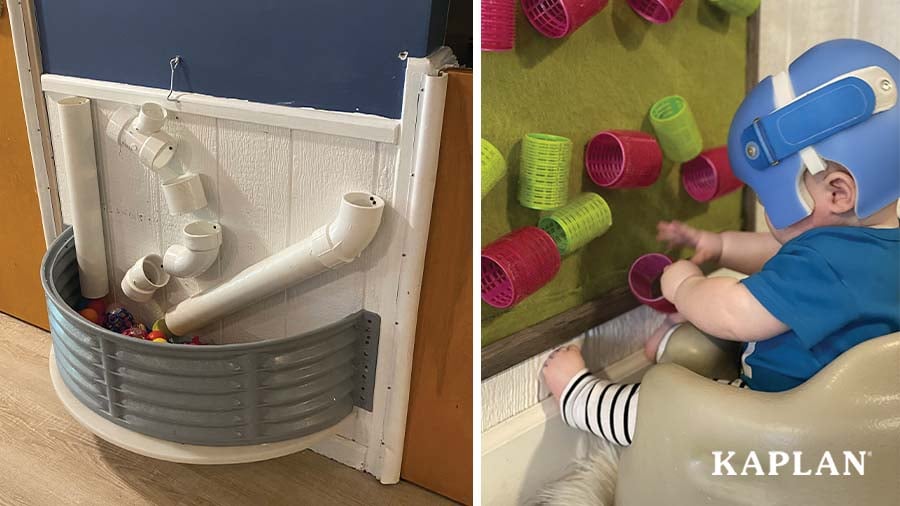 2. Pipes-and-tubes wall**
This vertical learning surface engages children’s curiosity, motor skills, and cognitive development as they watch the balls twist, turn, and tumble down the wall.
**What you’ll need:**
- Large PVC pipes with joints or elbow connectors
- Ping-pong-sized balls
- Large [basket](https://www.kaplanco.com/store/trans/search.asp?tbSearch=basket) or [storage bin](https://www.kaplanco.com/store/trans/search.asp?tbSearch=storage+bins) (to catch the balls)
- Zip ties or pipe clamps (for assembly)
- Wooden pallet or large [pegboard](https://www.kaplanco.com/product/46525/pegboard-25-hole) (for mounting)
**How it works:**
To start, create a winding tunnel by attaching PVC pipes and connectors to a wooden pallet or pegboard, working from the top down. Secure everything with zip ties or pipe clamps.
Mount the finished tunnel at a suitable height for toddlers and preschoolers. Place a basket or bin beneath the tunnel’s opening. Let children drop balls into the top opening and watch them roll through the pipes into the basket below.
**What it supports:**
As children repeatedly place balls into the top of the tunnel and watch them fall out of the bottom, they build spatial awareness and an understanding of cause and effect, all while practicing hand-eye coordination.
### **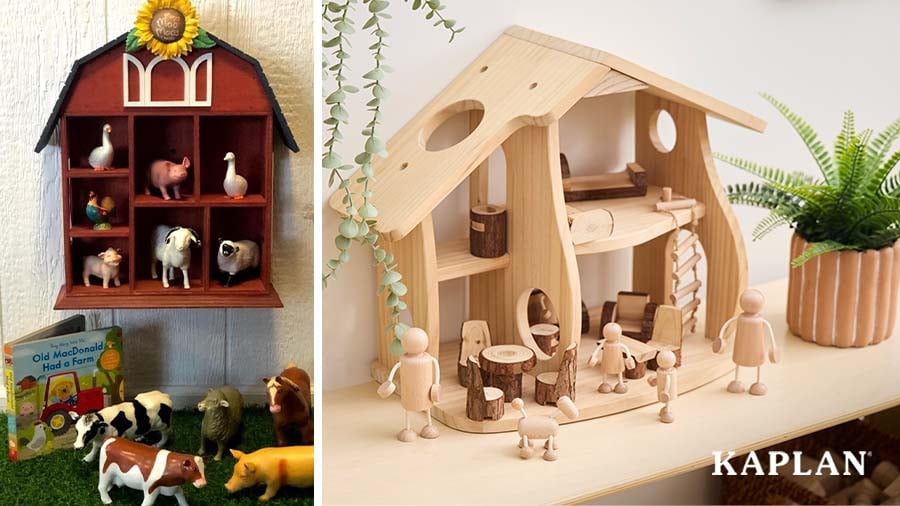 3. Mini worlds wall**
With this vertical learning experience, children can explore miniature versions of real-world environments right on the classroom wall.
**What you’ll need:**
- Cardboard box or miniature barn or [dollhouse](https://www.kaplanco.com/product/302498/furnished-wooden-classic-dollhouse?c=2%7CDP1021&at1=NEW) with open, easy-to-reach rooms
- Loose parts to fill the play environment
**How it works:**
Begin by creating a farm or house scene on your wall by mounting a dollhouse or cardboard boxes to the vertical space. Add items such as [farm animals](https://www.kaplanco.com/product/302140/my-little-world-farm-animal-set-10-pieces?c=24%7CIT1009), [miniature furniture](https://www.kaplanco.com/product/37894/multi-level-classroom-dollhouse-furniture-set?c=3%7CMB1040), and [play families](https://www.kaplanco.com/store/trans/search.asp?tbSearch=family+sets) so children can arrange and rearrange them during imaginative play.
**What it supports:**
These vertical wall worlds help children explore spatial concepts—such as above, below, inside, and behind—and strengthen their hand-eye coordination while promoting literacy and language development through pretend play.** **
## **Maximize your classroom space with vertical learning experiences**
Classroom walls aren’t just for posters, artwork, or parent communication boards. Like geckos, you can make the most of every inch by turning walls into vertical learning spaces that encourage hands-on exploration, support thinking and problem-solving, and strengthen both fine and gross motor skills—all while keeping children engaged.
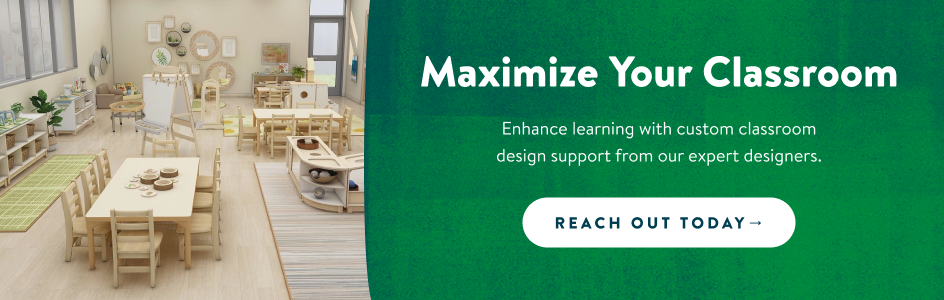
Ready to transform your walls into dynamic learning spaces? [Connect with our experienced classroom designers](https://www.kaplanco.com/resources/classroom-design.asp#form) who can help you make the most of every inch of your classroom— thoughtfully arranging furniture and learning materials for maximum educational impact. We’re here to help you turn every corner of your classroom—walls included—into a space that sparks curiosity, creativity, and healthy growth and development.
[](https://www.kaplanco.com/resources/classroom-design.asp#form)
###### Share this article:
- [** ](https://www.facebook.com/sharer/sharer.php?u=https://blog.kaplanco.com/3-tips-and-a-tool-for-for-designing-your-classrooms)
- [** ](http://pinterest.com/pin/create/button/?url=https://blog.kaplanco.com/3-tips-and-a-tool-for-for-designing-your-classrooms&media=https://4344835.fs1.hubspotusercontent-na1.net/hubfs/4344835/3%20Tips%20and%20a%20Tool%20for%20Designing%20Your%20Classrooms_SOP%20Wee%20Ones%20Classroom_RESIZE.jpg)
- [** ](https://twitter.com/home?status=3%20Tips%20and%20a%20Tool%20for%20Designing%20Your%20Classrooms+https://blog.kaplanco.com/3-tips-and-a-tool-for-for-designing-your-classrooms)
- **
## Related Posts

Classroom Setup
[How to Set Up Your Preschool Dramatic Play Learning Center](https://blog.kaplanco.com/ii/preschool-dramatic-play-learning-center)
May 30, 2014

Classroom Setup
[Setting Up Your Preschool Learning Centers](https://blog.kaplanco.com/ii/preschool-learning-centers)
May 30, 2014
Classroom Setup
[How to Set Up Your Preschool Nature and Science Learning Center](https://blog.kaplanco.com/ii/preschool-nature-science-learning-center)
May 30, 2014
Classroom Setup
[How to Set Up Your Preschool Block Learning Center](https://blog.kaplanco.com/ii/preschool-block-learning-center)
May 30, 2014
## Latest Posts
Grant Funding
[Gateway Children's Charity 2026 Grants for St. Louis Early Childhood Programs](https://blog.kaplanco.com/st-louis-early-childhood-program-grant)
July 22, 2026
Classroom Setup
[Why Organizing Classroom Materials Matters More Than You Think](https://blog.kaplanco.com/organizing-classroom-materials)
July 19, 2026
Classroom Setup
[From Launch To Growth: Kaplan’s Support for Charter Schools](https://blog.kaplanco.com/kaplan-support-charter-schools)
July 12, 2026
Outdoor Learning
[How to Design Outdoor Learning Spaces For Early Learners](https://blog.kaplanco.com/ideas-for-outdoor-learning-spaces)
June 28, 2026
Resources at your fingertips
### Get Learning Center Updates
Subscribe to get email updates whenever new resources are available in our Learning Center.
[ Subscribe Now ](https://info.kaplanco.com/kaplan-learning-center-subscription-form)
[**
Request a Catalog
](https://www.kaplanco.com/CustomerService/catalogRequestForm.asp)
[**
Premium Delivery Services
](https://www.kaplanco.com/about/delivery-services)
[**
Free Classroom Floorplanner
](https://www.kaplanco.com/resources/floorplanner.asp)
[**
Learning Center Free Resources
](https://blog.kaplanco.com/)
###### Quick Links
- [Classroom Links](https://www.kaplanco.com/resources/retrieveListForm.asp)
- [Financing](https://www.kaplanco.com/resources/Financing.asp)
- [myKaplan](https://www.kaplanco.com/secure/myKaplan/LogOn.asp)
- [Quick Order](https://www.kaplanco.com/store/trans/quickOrderForm.asp)
- [Online Payments](https://www.kaplanco.com/pay)
- [Kaplan Warranties](https://www.kaplanco.com/CustomerService/Warranty)
- [GSA Customers](https://www.kaplanco.com/GSA/)
- [Credit Application](https://www.kaplanco.com/secure/customerService/creditApplication.asp)
- [Order Tracking](https://www.kaplanco.com/secure/CustomerService/orderTracking.asp)
- [Returns](https://www.kaplanco.com/secure/CustomerService/RMA_Start.asp)
- [Exclusions](https://www.kaplanco.com/exclusions)
- [Outlet Store](https://www.kaplanco.com/about/showroom.asp)
###### About Kaplan
- [About Us](https://www.kaplanco.com/about/index.asp)
- [Customer Support](https://www.kaplanco.com/about/contactKaplan.asp)
- [Careers](https://www.kaplanco.com/about/Careers.asp)
- [Diversity, Equity, and Inclusion](https://www.kaplanco.com/about/diversity-equity-inclusion)
- [Partners](https://www.kaplanco.com/about/partners.asp)
- [Meet Our Reps](https://www.kaplanco.com/Kaplan-Representatives)
- [Shipping Policies](https://www.kaplanco.com/CustomerService/ShippingInfo.asp)
- [Product Safety](https://www.kaplanco.com/about/productSafety.asp)
- [Privacy & Security](https://www.kaplanco.com/about/privacy.asp)
- [Terms of Payment](https://www.kaplanco.com/about/termsOfPayment.asp)
- [Kaplan W-9](https://www.kaplanco.com/content/Kaplan-W9.pdf)
[](https://blog.kaplanco.com/vertical-learning-experiences#)
[1-800-334-2014 ](tel:18003342014)• [Email](mailto:info@kaplanco.com)
- [**](https://www.facebook.com/KaplanCo)
- [**](https://pinterest.com/KaplanCo/)
- [**](https://twitter.com/KaplanCo)
- [**](https://www.linkedin.com/company/kaplan-early-learning-company)
- [**](https://www.youtube.com/c/kaplanco)
- [**](https://www.instagram.com/kaplanco/)
- [**](https://www.tiktok.com/@kaplanelc)
Copyright © 2024 Kaplan Early Learning Company. All rights reserved.
```json
{
"@context" : "https://schema.org",
"@type" : "BlogPosting",
"author" : {
"@type" : "Person",
"name" : "Latoya Torrance",
"url" : "https://blog.kaplanco.com/author/latoya-torrance"
},
"dateModified" : "2026-04-19T13:15:00.715Z",
"datePublished" : "2026-04-19T13:15:00.000Z",
"headline" : "Vertical Learning: How To Turn Classroom Walls Into Engaging Learning Spaces",
"image" : [ "https://blog.kaplanco.com/hubfs/blog_imgs/BLOG_Vertical%20Learning%20How%20To%20Turn%20Classroom%20Walls%20Into%20Engaging%20Learning%20Spaces_header_img_1200x600.jpg" ],
"mainEntityOfPage" : {
"@id" : "https://blog.kaplanco.com/vertical-learning-experiences",
"@type" : "WebPage"
},
"publisher" : {
"@type" : "Organization",
"logo" : {
"@type" : "ImageObject",
"url" : "https://blog.kaplanco.com/hubfs/KELC_Full_RGB_Screen.png"
},
"name" : "Kaplan Early Learning Company"
}
}
```